

Leet Speak 101
All this talk about our soon-to-be-dead-language reminded me of the “1337 sp3ak” phenomenon.
Here’s your first lesson:


Follow Us on TikTok

All this talk about our soon-to-be-dead-language reminded me of the “1337 sp3ak” phenomenon.
Here’s your first lesson:

You may have noticed recently that Twitting is all the rage now.
Last week, George Stepnanopolis conducted the worlds first network Twitter interview with John McCain. Celebrities are twitting all over the place. Senators were twitting during the President’s recent address to Congress. I guess you could say that the twits are everywhere.

In the wake of Jon Stewart’s public evisceration of CNBC last week, an internet petition is circulating to compel the network to change its ways.
While I’m sure this project was organized with the best of intentions, do the folks at Fixcnbc.com really expect CNBC executives to stop listening to the directives of their corporate overlords?
Stewart already exposed the nature of this cable channel’s (and many other networks) scam. CNBC has certain financial interests to protect, and creates programming most likely to disseminate favorable opinions of those interests. Period. It’s not as if CNBC was once a bastion of objective, investigative journalism that somehow lost its way. A majority of the hosts on its shows aren’t even professional journalists — just business community fluffers.
Only a truly massive public fervor would compel NBC to take action to ensure that CNBC once again acted as the Consumer News and Business Channel. Don’t expect that to happen anytime soon.
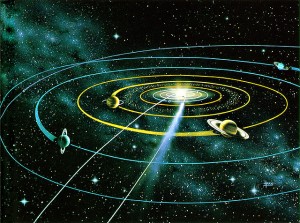
I don’t mean to be telling tales out of school, but friend and fellow Mepper, Storily Clayton, once shared with me a theory of time that I found both brilliant and strangely comforting.
The idea is as follows: If we think of time as the position of the Earth in relation to the Sun (which is how we typically measure a year), any given time is actually a very specific geographical position in the Earth’s orbit. In other words, the Earth is in a nearly identical spot today as it was a year ago. And so am I, and so are you, as are all other passengers on the giant blue sphere as it careens through space. We are constantly traveling through “time” at over 66,000 miles per hour around an orbital track over 585 million miles long.
This gives a strangely physical or spatial quality to time. And lends a lot more credence to the relativists’ notion of Space/Time as a single entity.
It also warrants a new type of observation. Are we prone to certain behaviors or actions at certain times of the year because we find ourselves in the same geographical location?
I mean, think about how returning to a formative location (a school you graduated from, a house you spent your childhood, a old familiar dive bar) affects your thoughts and brings back certain old lines of thinking, certain memories.
Now realize that visits to those locations are randomly strewn about space; each visit to the school (that wasn’t an anniversary of another visit) could have taken place hundreds of thousands of miles apart from each other (in the context of where you are in space). Relatively speaking, the only time when you’re anywhere near in the same place as you had been before, is on the yearly anniversary of a given day. Even if you are on the other side of the planet (having a circumference of about 25,000 miles) on that anniversary you’re still much closer to your location on that anniversary than a half hour later, when you’ve moved another 30,000 miles down the orbital track.
So Mr. Clayton often uses his blog as an empirical analysis of how different times tend to affect him. And I’ve begun to buy into this line of thinking. I just re-listened to Mep Report 18, an absolutely phenomenal specimen that we recorded almost exactly three years ago. And I listened to myself wrestle with life questions that have been occurring to me very recently. I suppose I can only truly be in the same mental “space” as I was for TMR 18 during this time of year.
Some food for thought.

Once upon a time, I participated in an MMORPG called Dark Age of Camelot.
My character was a precocious half-elf champion with the unlikely name of Skystrider Antilles. He, and other Mep House avatars vigilantly defended the lands of Hibernia.
But that is a tale for another time. Today I want to share an old piece of short fiction that stemmed from DAOC lore and my frustrations with ISP provider, SBC Yahoo!
Here’s an incredibly important presentation that took place at the New York Public Library. This particular excerpt features internet champion, Lawrence Lessig talking about YouTube’s influence on the sharing of media.
The full program can be found here.